Wednesday, November 28, 2018

Nov 18 - Heading South

Today was a travel day. We flew into Punta Arenas at the bottom of Come, then drove north to Torres Paines National Park.
My first view of Patagonia was the picture here. The mountain in the background with the sculpture of people flying fit the area (whether because of the crazy winds or the people who are crazy to live here, I'm not sure). It's stark, and beautiful, and life is hard, but lovely. Such dichotomy, and yet it somehow makes complete sense.
On the way to the farm where we will be staying, we stopped at a cave formed over 13,000 years ago from glaciers and water erosion. Based on remains in the cave and surrounding area, they have identified several types of animals that no longer exist. One such animal was the macrauchenia, which sort of looked like a camel with a short elephant's nose. Another was the milodon, seen here.

Bonus Pictures: 


Nov 17 - Geysers del Tatio @ 14,000 Feet

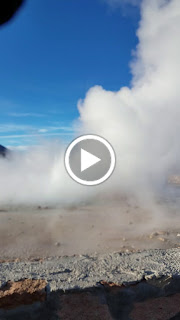
Got up very early (3pm!) to travel to the geothermal geysers. It is the world's highest geothermal field (14,000 feet above sea level) - so breathing is a huge issue.


It was cold when we arrived just after sunset - like a pleasant winter day in Cleveland. We started at the highest point of the day in the geyser field - there are many geysers here. But unlike Old Faithful or others I have watched, there isn't a sudden burst of water coming out of the ground. These are basically holes in the earth where steam comes out, and every once in a while, hot water spirts a little bit.  But mostly the steam is just about water meeting the early morning cold air, creating clouds of steam. By the time we left the geyser field, the steam was drastically reduced due to the warmer temperature.


The geothermal area is filled with minerals. The country has to decide, do we keep this as a tourist site, or mine the area. At one time there was pump mining one of the cracks in the "geysers". It caused many of the surrounding "geysers" to dry up (unfortunately they left the pump behind). But if they decide to mine again, the cost will likely be felt in tourism. It's this enough to keep them away? Well see.

Next we headed down a few hundred feet to another area smaller, geyser field and a geothermal bath. Only 4 or 5 of us decided to go in the water - the rest didn't want to deal with the cold weather when they got out. The worst was not getting out, it was the freezing tile in the changing rooms.

The bath was nice, but nothing compared to Iceland's "hot pot". The pool looked natural. The water is fed in from one side where the water is only ankle high. I found a spot not to far from the shallow area where I could be submerged. But by then, the water had already lost some heat from the cold temperatures outside. Some were at the other end of the pool (on purpose!), where the water had cooled considerably - definitely not my thing. 

We enjoyed a quick breakfast, then headed of to explore the area.  Eventually, we had to head home.  Along the way, we saw another of the type of the cactus in the area. I had been told there was a couple. It looked funny though - like someone forgot to vshave their legs.

We head out tomorrow for the main part of the tour, where we will be joined by a few more people.

Bonus Pictures: 


Monday, November 26, 2018

Nov 16 - Archeology and Flamingos


In the morning we had an archaeological tour.

First we visited a 3000 year old pre-Columbian village. We saw lots of artifacts that have been dug up (like us in Lake County, the only thing they know is based on trash piles and remnants left behind). Based on the various cultures reflected in their artifacts, they believe they were on a major road which allowed for much trading with other peoples.

 Oldest excavated ruins. Note circles in background.

 We could see the placement of the homes based on the ground - about  one or two feet of the walls were sticking above the sand. The houses were interconnected circles. Then we found out we were seeing the top of the homes. The homes have been buried over the years by blowing sand. 

Licancabur from re-creation doorway

They also had a re-creation of two houses. T
he doors of the homes faced the largest mountain, Licancabur, or "Mountain of the People". It was a special mountain to the early people, because it fed them.  

You see, this whole area is in the Atacama Desert. San Pedro, where we are staying is an oasis in the desert (never thought I'd stay at an oasis!), as is the area where the horses are built. It only rains 3-4 times a year. The oasis is watered by melting snow from the area mountains. So, in essence, Licancabur, being the largest mountain, fed the early people.

Next we visited Pukara de Quitor, a fortress from the 12th C. It was built on the side of the mountain, and the only entrance was at the top, so they could clearly see anybody trying to invade and protect themselves. It saved them from the Incan invasion, but, unfortunately, not the Spanish invasion in the 16th C.

There were artifacts at this site too. It's amazing to me how many things were similar to our natives. I liked the large cactus needles they used as knitting needles.

In the afternoon, we passed by ALMA (Atacama Large Millimeter Array), the largest viewer of the sky, picking up space objects 100 times faster than before. It is operated by multiple countriesI. This is a perfect site for it because i'd the high altitude and lack of clouds (like rain, there is seldom a cloud in sky). 


We stopped at Eglesia San Pedro. Thre front door is made it of a unique cactus here. The holes used to tie the bark  together is natural. It is from the quills on the cactus. The cactus has a bark-like covering over a hard interior (more like trees than traditional cacti). 


The afternoon was spent enjoying flamingos, followed by another beautiful sunset and snacks with wine. We had hoped to see a predator hunting the flamingos, but no luck.


Bonus pictures: 

There's something wrong with this message...